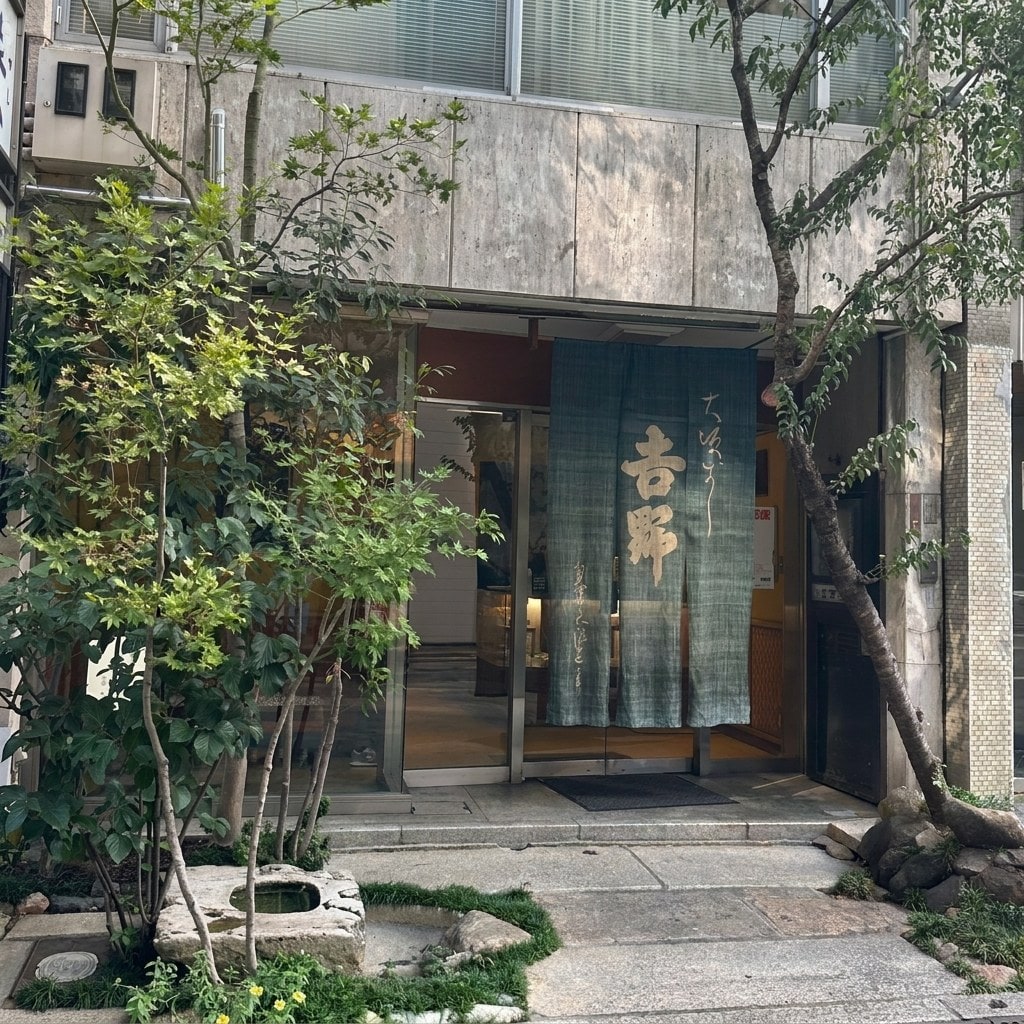
Yoshino‑zushi has stood in Semba, Osaka’s old merchant quarter, since 1841 — the year Tenpō 12 — when an inn turned itself into a sushi house. In the Meiji era the third master, Torazō, took the pressed sushi of his day — a plain, popular thing of a single fish — and rebuilt it with sea bream, prawn and conger eel, each given the simmering, grilling and vinegar work of formal Japanese cooking, then pressed in a hinoki (Japanese cypress) mold of two sun six bu — about 8.5 centimeters — square. The composition was so dense it earned the name “a kaiseki — Japan’s formal multi‑course cuisine — in two sun six bu.” Osaka box sushi begins in this house.
What you eat
The box. The seventh master, Hashimoto Takuji, retired the hand‑formed nigiri entirely so the house would remain purely Osaka‑zushi. Every element is made within these walls, without preservatives: the seasoned sea bream, the char‑grilled anago — conger eel — the thick tamago omelet, layered with simmered shiitake and nori into that small lacquered geometry. Around it stand the rest of the Osaka repertoire: bō-zushi (fish pressed along a stick of rice), the house’s own Yoshino‑maki roll of anago, tamago and shiitake, battera — the mackerel box that is Osaka’s everyday classic — and a warm steamed anago sushi in the cold months. This is sushi engineered by Semba’s wholesale merchants to be carried, to hold shape and flavor, to reach the counting houses at midday. Take‑away is not a compromise here; it is the original form, older than any counter.
The booking reality
There is no table to reserve, and we will not pretend otherwise. The house sells weekdays only, 10:00 to 14:00, take‑away only — the second floor, 24 seats between an 8-seat counter and 16 at tables, is closed as of September 2026. The phone takes orders from 9:30 to 18:00, in Japanese, and popular boxes can be gone before the midday trade if left to chance. Saturdays, Sundays, holidays and the year‑end the house closes. Cards work — Visa, Mastercard, JCB, AMEX, Diners — but no e‑money. What our desk does is place that call: your boxes set aside under your name, a pickup time that fits your day, and honest word if the upstairs seating ever returns.
Go if you
Travelers who want to taste what sushi was in Osaka before Tokyo’s nigiri conquered the word — and who like the idea of eating a 180-year‑old design, boxed, on a bench by the Yodo River.