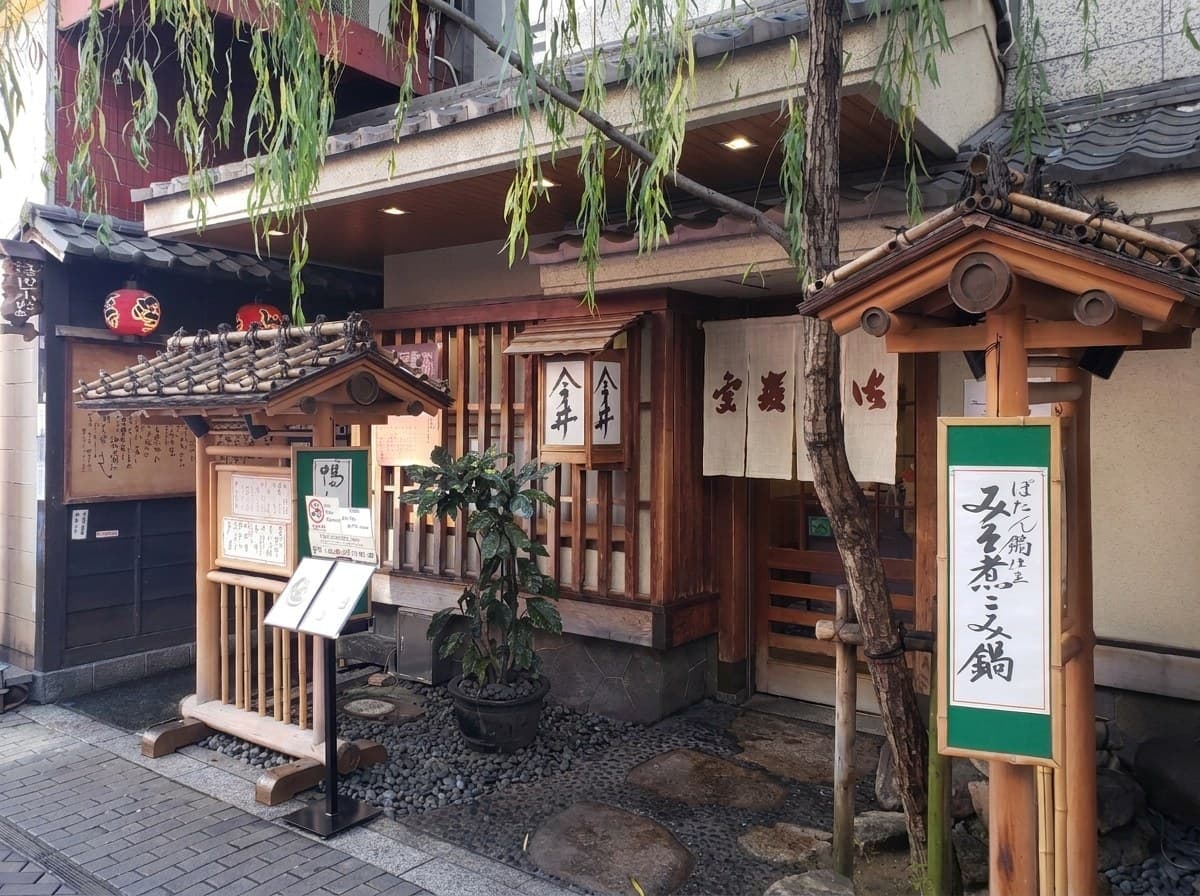
Dotonbori Imai is the udon house to visit if you want to understand Osaka’s kitsune udon, and you do not need a reservation to eat there. The honten, the main shop on the Dotonbori canal strip, was founded in 1946. Walk in, ideally at the 11:30 opening or in the middle of the afternoon, order the kitsune udon, and finish the broth. Only course meals, such as the udon hotpot, are booked ahead.
From a theatre teahouse to a bowl of udon
Imai’s own published history begins long before noodles. According to the house, its first head moved to Dotonbori from Imai‑cho in Nara around 1815, and in 1838 his daughter Take opened a theatre teahouse called Inatake opposite the Naka‑za playhouse, when this street was the heart of Osaka’s theatre district. A later generation passed the teahouse on and opened Imai Gakki‑ten, a shop selling Western musical instruments that, as the house tells it, prospered alongside the craze for jazz on Dotonbori.
The air raids on Osaka in 1945 burned the family out. Back on Dotonbori in 1946, Kanzo Imai and his wife Machiko sold whatever would keep them going: kanten jelly and shaved ice in summer, zenzai and roasted chestnuts from autumn. Noodles, sold quietly on the side, drew customers, and the business became a shop for soba and udon. The house credits Machiko with completing its dashi in 1949 after years of searching, and it incorporated in 1956. The willow at the door, according to a history site supervised by the family, was planted in 1946 while the building was still a makeshift shack. A fire in 2002 spread to the honten; the house rebuilt and carried on.
What makes Osaka udon different
When Osaka and Tokyo argue about udon, the argument is almost always about the broth. In the Kanto region the typical noodle broth leans on katsuobushi and dark koikuchi soy sauce, and it arrives deep brown. Osaka builds its broth on kombu, seasons it with pale usukuchi soy sauce, and serves it light gold and nearly clear. Pale does not mean bland: usukuchi soy is lighter in color but saltier than the dark style, so the seasoning is present, only quieter, and the kelp carries the bowl. Japan’s agriculture ministry, in its regional food archive, describes Osaka’s kitsune udon broth as built mainly on makombu kelp and dried fish such as mackerel flakes.
The noodles tend to follow the broth. The same archive describes Osaka udon as not too thick, with a soft, gently springy chew, so the noodle takes on the dashi rather than competing with it.
Imai’s dashi is a precise example. The house uses natural makombu kelp from southern Hokkaido, brought to the boil slowly and then simmered for close to an hour. Once the kelp is lifted out, finely shaved saba‑bushi (mackerel) and urume‑bushi (round herring) go in at a ratio of one to two, with souda‑katsuo among the listed ingredients, and the broth is finished in an eight‑sho pot, about fourteen litres.
Where kitsune udon came from
Kitsune udon is plain udon topped with a sheet of sweet, soy‑simmered abura‑age, or fried tofu. The name, “fox,” is usually explained by the old association between foxes, the messengers of Inari shrines, and fried tofu.
The most widely cited origin story belongs to another Osaka house. Japan’s Ministry of Agriculture, Forestry and Fisheries says kitsune udon is said to have begun in 1893 at Matsubaya, an udon shop in the Semba district, today Usami‑tei Matsubaya, when customers put the fried tofu served on the side onto plain udon. The shop’s Japanese Wikipedia entry notes that other theories exist, and Imai’s own timeline dates the idea of fried tofu in udon to 1877, placing the sweet simmered version after 1894. The fair reading is that Matsubaya holds the best‑known claim, and that Imai, founded half a century later, did not invent the dish but became one of its most celebrated keepers.
What to order at Imai
Order the kitsune udon first. The house describes it as a balance of three things: gently sweet fried tofu, its kelp and dried‑fish dashi, and springy udon. The honten’s official page lists it at ¥930 including tax as of September 2026. Drink the broth; it is the reason the shop exists.
After that, the menu rewards reading. Tempura udon is deliberately spare, one very large prawn and green onion, fried by a method the house credits to the generation that ran the instrument shop. There is nabeyaki udon in its own pot (¥1,850 at the honten), oyakodon with a clear soup (¥1,500), nishin udon with herring, and soba for those who prefer it, including a seasonal soba that changes monthly; for September 2026 the honten announced a steamed Wakasa‑style soba with amadai and matsutake. The house notes that menus and prices vary by shop and season.
When to go, and the one meal you can book
The honten opens at 11:30 and closes at 21:30, with last orders at 21:00 according to its official shop page, and hotpot last orders at 19:30. It closes on Wednesdays, opening when a Wednesday is a national holiday, and on the fourth Tuesday of each month except December. It is about five minutes on foot from Namba Station on the Midosuji subway line. Hours change, so check the shop page before you go.
For udon there is no booking; you walk in. The room is large, 138 seats by Tabelog’s count, so a line at the lunch peak or in the evening usually keeps moving. The quiet windows are the opening and the middle of the afternoon, when the shop serves straight through.
The exception is the course meal. The honten’s Tabelog listing asks that reservations be made by the day before, for course meals such as the hotpot. The signature is the udon yosenabe, ¥5,500 per person at the honten: vegetables, grilled conger eel, simmered shiitake, fu, yuba, chicken and kuruma prawn, in a pot where, the house says, the udon is eaten alongside everything else rather than saved for the end. Bookings go directly to the shop by telephone in Japanese (06‑6211‑0319) or by fax using the form on the official site; the shop does not take reservations by email.
Planning the rest of your Osaka evenings
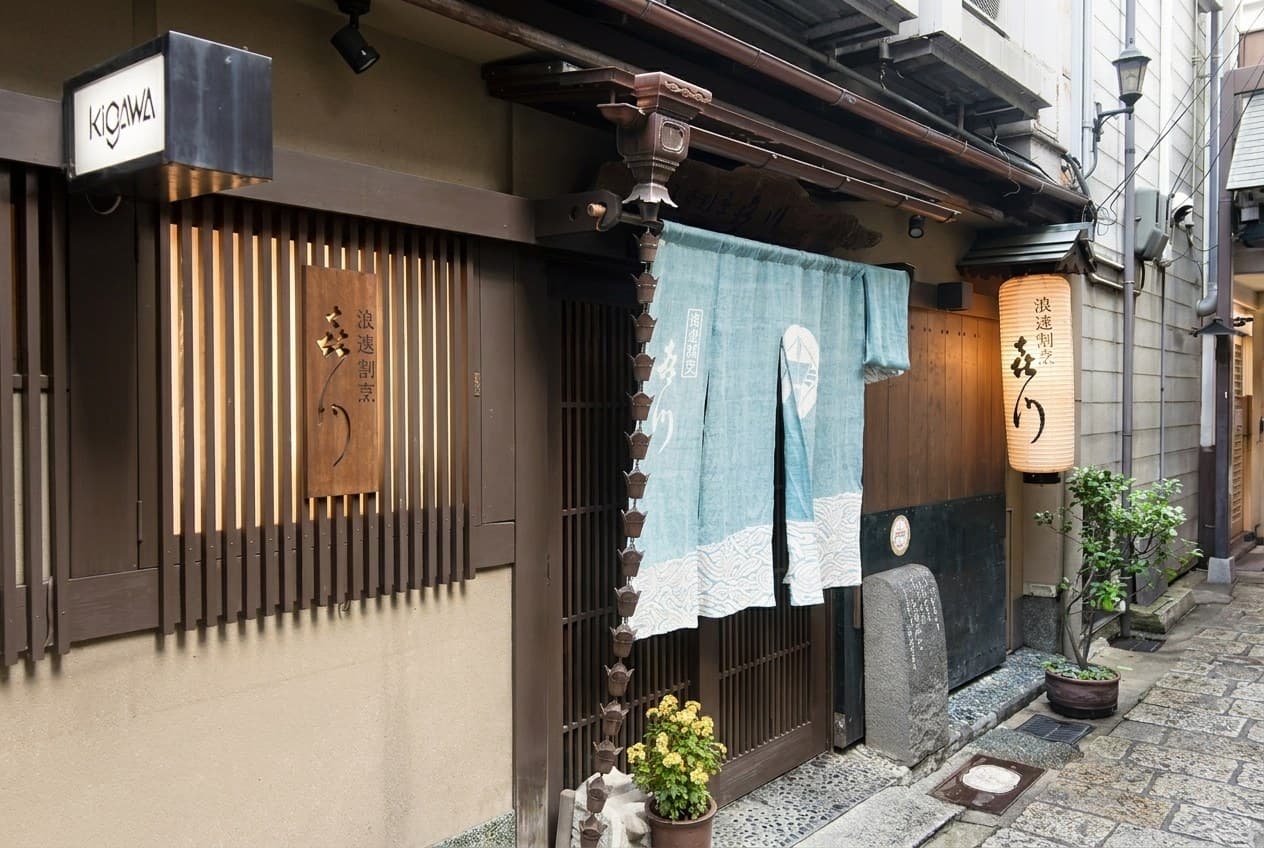
Imai is the easy part of an Osaka trip: no call, only timing. The kappo counters that define the city’s evenings are a different matter, since most of their seats move by telephone in Japanese, with some houses opening a portion online. Naniwa Kappo Kigawa, in Hozenji Yokocho a short walk from Dotonbori, takes bookings by phone in Japanese or through Ikyu, usually a few weeks out. For how the harder houses release seats, read how to book fine dining in Osaka; for tables you can realistically secure, see the best restaurants in Osaka you can actually book.
If a dinner needs a Japanese phone call you cannot make from abroad, you can send us a request. Requesting is free; when a seat is held we ask you to approve it, and the fee is charged only after you approve. For the kitsune udon, none of that applies: pass the willow at 11:30 and walk in.