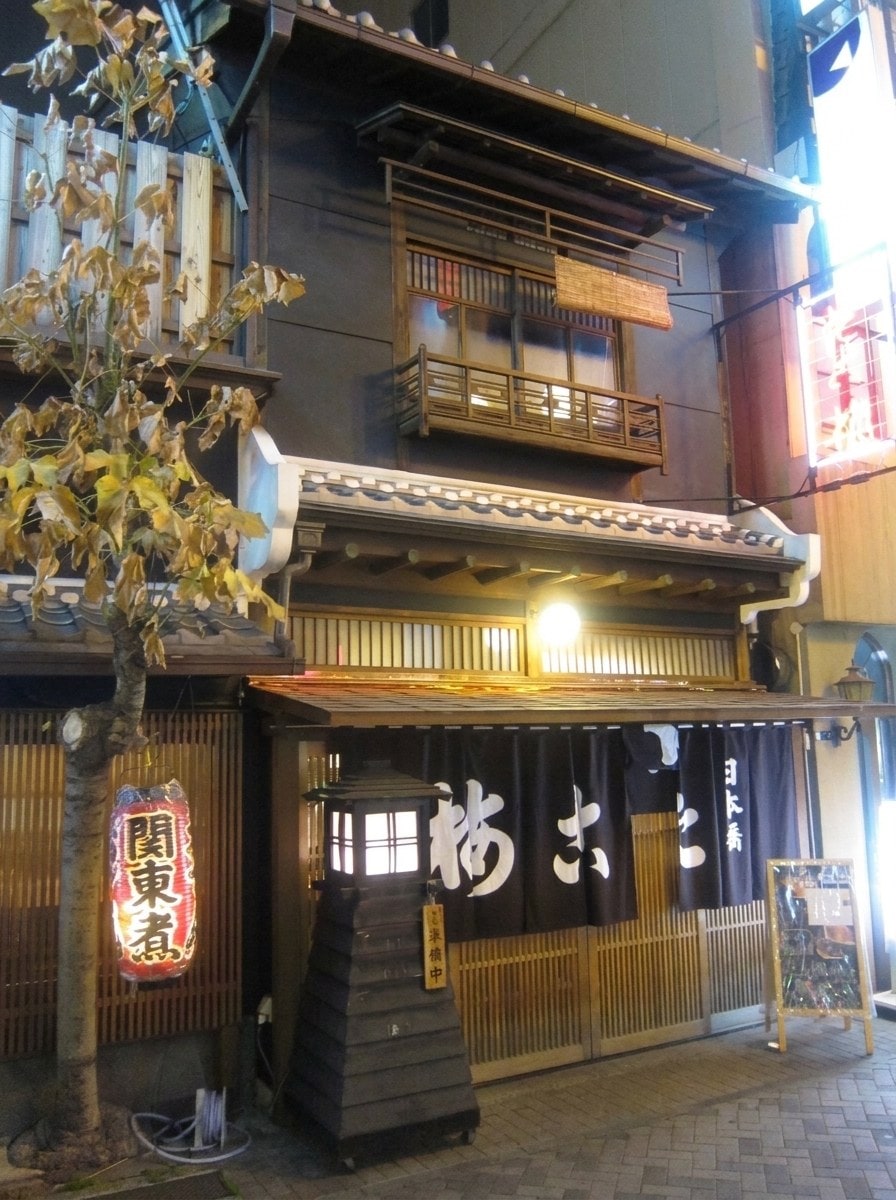
Japan's oldest oden house, poured with warm sake since the year 1844.
By SHOKU NOREN TeamFacts last verified September 2026How we check
Request this table¥6,000 per seat, only if we secure it.This house books only in the name of the guest who attends. We will ask in your name; if the house declines bookings arranged on a guest's behalf, we will tell you and nothing is charged.Remind me before it opens
In shortOden — Kansai kanto-daki, taste of tamari and warm sake. Reservations run in Japanese and are hard to place from abroad, so our Tokyo desk requests the table for you, by phone and in Japanese.
Price
Casual — oden by the piece, with sake
Hours
16:00–21:50 — evenings only (shortened in February 2024; confirm before a late visit)
Closed
Dec 31–Jan 3
Seats
21 — 12 at the counter and 9 at tables
Payment
Cards accepted (no e-money or QR codes) · ¥275 seat charge per person
Getting there
Dotonbori
Takoume calls itself the oldest oden house in Japan, and the paper
trail backs it: founded in 1844 — the first year of the Kōka era — by
Umejiro Okada on the Dotonbori canal, with five generations of the
family keeping the pot going since. The name splices the counter
format the founder worked, called tako, with the ume of his own
name. Learn the local vocabulary before you sit down: in Osaka, oden —
vegetables, tofu and fish cakes simmered for hours in seasoned broth —
goes by kanto‑daki, “the Kanto‑style simmer,” a dish adopted from
eastern Japan and made the city’s own.
What you eat
Two things carry the house. Tako kanro‑ni — octopus simmered slowly
in a sweet glaze until glossy and tender, on the menu since the
founding year — and the kanto‑daki itself, each piece steeped in a
dark broth scented with tamari, a thicker, rounder cousin of soy
sauce, until it takes on the color. The founder is remembered for a
third: saezuri, whale tongue, which the house records as his
addition to the pot — a first in Osaka’s oden history. Take it the old
way, one piece at a time, between sips of jokan — sake warmed to
just above body heat; the shop still describes itself as a jokan‑ya, a
warm‑sake house, before anything else.
The counter, in practice
The Dotonbori honten has twenty‑one seats — twelve at the counter and
nine at tables — and opens evenings only, 4:00 p.m. to 9:50 p.m. (the
hours were shortened in February 2024), closed just December 31
through January 3. Seats carry a ¥275 cover and a
two‑hour limit, and the room fills early with people who did not
wander in by accident. The useful part: unlike most counters this size, Takoume takes
reservations — by telephone only, in Japanese, from 15:00, up to one
week ahead (a month ahead for members of the house’s FUN club). The
booking must be in the diner’s own name: the house cancels proxy
bookings when someone other than the named guest arrives, so we
request it in the name of the guest who attends; if the house declines a booking arranged on a guest’s behalf, we will tell you and nothing is charged.
Most
travelers queue on the canal without ever learning any of this.
Pull up a stool if
You would rather spend an Osaka evening at a 19th-century counter,
one piece and one warmed cup at a time, than sit down to anything
grand.
Free release-date alerts: the day before, on the morning of release day (08:00 JST) and about 30 minutes before when the time is known — or a weekly summary if the house opens a little every day.
Takoume: common questions
Can you book Takoume from abroad?
Yes, through our Tokyo desk. Phone only, in Japanese (06-6211-6201, from 15:00); the public can book from one week ahead. The booking must be in the diner's own name — proxy bookings are cancelled if someone else turns up. Or come early and wait. We call the restaurant for you, in Japanese, and the ¥6,000-per-seat fee is charged only if we confirm your table — no seat, no fee.
Some of these links are referral links: if you book through them we may earn a small commission, at no extra cost to you. Restaurants never pay us to be listed or ranked. Editorial policy
Cite this page
Facts on this page were checked by our Tokyo desk. You are welcome to quote them with a link: