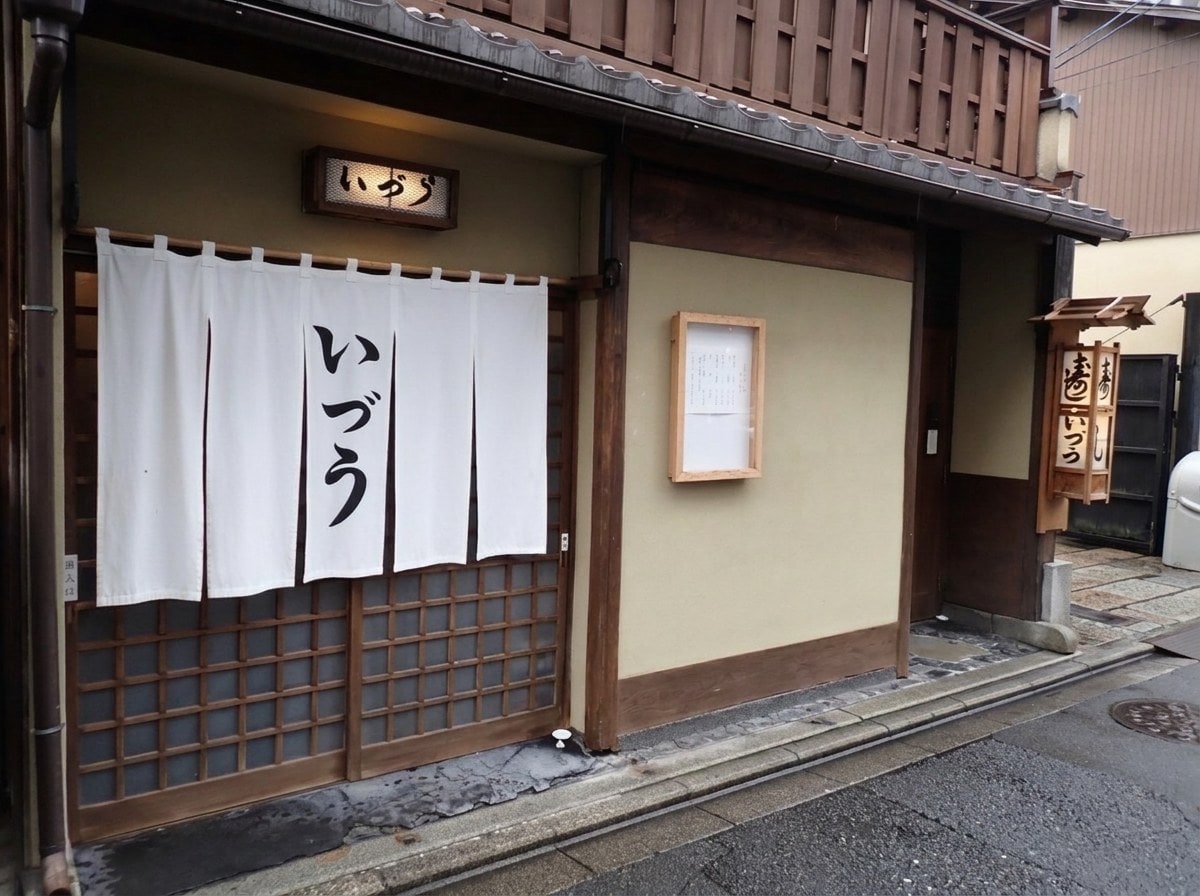
In shortKyoto sushi — pressed mackerel, the original saba-zushi. Reservations run in Japanese and are hard to place from abroad, so our Tokyo desk requests the table for you, by phone and in Japanese.
Price
A la carte — saba-zushi ¥2,200 for four pieces; takeaway from ¥3,240 (six pieces of saba-zushi, tax included)
Tuesdays — open when a public holiday or festival falls on a Tuesday
Seats
A small dining room in the Gion house; takeaway boxes, and a counter in Daimaru Kyoto's basement
Payment
Cards, e-money and QR codes all accepted
Getting there
Down a lane in Gion
Izuu opened in 1781 and has spent the nearly two and a half centuries since
on essentially one dish: saba‑zushi — salted mackerel pressed onto
vinegared rice, the style it is credited with originating. Kyoto sits
inland, a day or more from the sea in the era before refrigeration, so
the city built its sushi around fish that had already been cured to
survive the journey. Izuu is where that necessity became a form.
What you eat
Mackerel salted on the Wakasa coast and carried in along the old Saba
Kaido — literally “the mackerel road” — is pressed with vinegared rice
into a bar, then wrapped whole in a broad sheet of kombu (kelp). The
kelp is not a garnish but the method: it seasons the fish, keeps it
moist, and is peeled back at the table before you eat. Four pieces run
¥2,200; there is also a sea‑bream version, a Kyoto‑style chirashi
(scattered sushi over rice), and little else. The result is dense,
clean and faintly sweet‑sour — sushi built for a city with no fish
market, and better a few hours after pressing than the moment it is
made.
The booking reality
There is no reservation war here, and that is easy to misread. The
Gion house keeps one small dining room, open 11:00 to 22:00 and closed
Tuesdays, and most trade is walk‑in or takeaway boxes ordered ahead by
phone, in Japanese. The catch for a traveler is different: the room is
tiny, the staff work in Japanese, and the thing worth planning — a box
timed to your Shinkansen, or a whole pressed mackerel for a picnic
along the Kamogawa — has to be ordered in advance by phone. That call,
placed in Japanese with your pickup time fixed, is the whole trick;
the desk makes it in a minute.
Care where dishes come from. This is the founding document of Kyoto
sushi — the actual house, not a revival — and at ¥2,200 for four
pieces it may be the cheapest piece of living culinary history in the
city. Eat it in the room once; carry a box away the second time, the
way Kyoto always has.
Free release-date alerts: the day before, on the morning of release day (08:00 JST) and about 30 minutes before when the time is known — or a weekly summary if the house opens a little every day.
Izuu: common questions
Can you book Izuu from abroad?
Yes, through our Tokyo desk. Walk-in for the small dining room; phone in Japanese to order ahead or reserve a takeaway box. We call the restaurant for you, in Japanese, and the ¥6,000-per-seat fee is charged only if we confirm your table — no seat, no fee.
Some of these links are referral links: if you book through them we may earn a small commission, at no extra cost to you. Restaurants never pay us to be listed or ranked. Editorial policy
Cite this page
Facts on this page were checked by our Tokyo desk. You are welcome to quote them with a link: