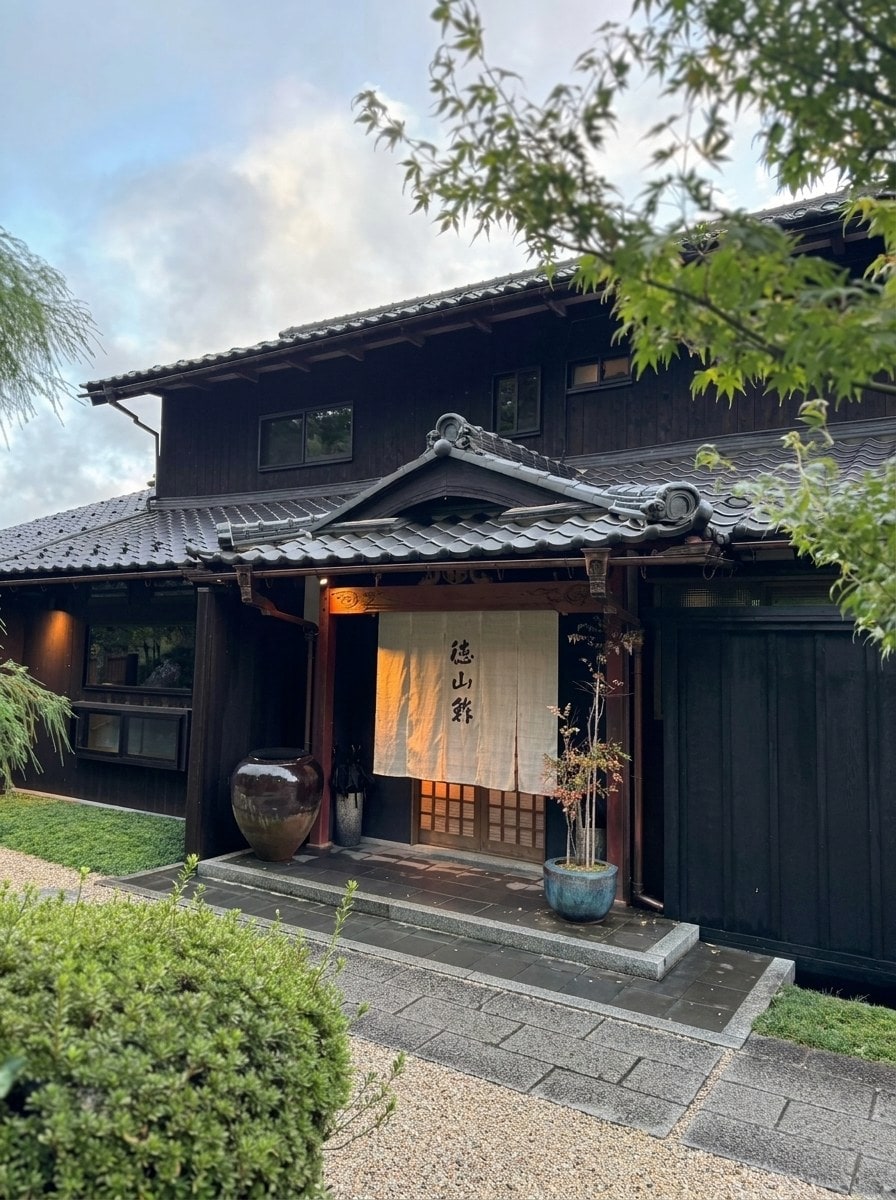
An auberge of five rooms on the shore of Lake Yogo, where a fisherman's son ferments the lake itself — funazushi a full year in rice, served with honey and sansho.
By SHOKU NOREN TeamFacts last verified September 2026How we check
In shortFermentation cuisine — funazushi, mountain game and lake fish on the shore of Lake Yogo. Reservations run in Japanese and are hard to place from abroad, so our Tokyo desk requests the table for you, by phone and in Japanese.
Price
Lunch ¥22,000 · dinner ¥27,500 · tax included, drinks separate
Hours
Lunch 12:00–14:30 · Dinner 18:00–21:00 · omakase only
Closed
Irregular holidays — confirmed by phone
Seats
Five guest rooms above the lake for stays · minimum 2, up to 10 per group · no children, no video in the house
Private rooms
The house is an auberge — five rooms, an open-air bath, one night with dinner and breakfast from ¥49,500 per person
Payment
Cards accepted for stays; confirm for dinner-only when booking
Getting there
20 minutes on foot from JR Yogo station — pickup can be discussed when booking · 10 minutes by car from Kinomoto IC
Tokuyama Hiroaki was born in 1960 into a fisherman’s family on Lake
Yogo, the small, still lake in the snow country north of Biwa. He
trained at Kawashige, a Kyoto ryōtei (a traditional high‑formal
restaurant), came home as head chef of the lakeside inn, and there met
Koizumi Takeo, the fermentation scholar who directed an institute at
Yogo. Out of that meeting — and with his wife Junko — he opened
Tokuyamazushi on the shore in 2004: an auberge of five rooms above the
water, and a kitchen that treats fermentation as the local grammar
rather than a technique.
What you eat
The center of the table is funazushi — the ancestor of all sushi,
whole fish fermented in cooked rice until the rice itself becomes the
seasoning. Here it is roe‑bearing nigoro‑buna, a crucian carp that
lives only in the Biwa basin, salted for six months and then a full
year in rice, served with honey and sansho (Japanese mountain pepper)
— the acidity rounded, not disguised. Around it, the seasons of deep
Kohoku: mackerel narezushi (the same slow ferment) with cheese and
tomato; a winter hotpot of white‑fatted bear brought in by local
hunters; boar, deer and duck; wild lake eel over charcoal; and to
finish, a rice ice cream of the master’s own patent. Lunch is
¥22,000, dinner ¥27,500, omakase only — the kitchen decides.
The booking reality
The telephone, in Japanese, answered 10:00 to 17:00 — there is no
online book. Recent first‑time callers report the earliest table
around five months out, and guests at the table booking their next
visit have been given dates eight months ahead; winter, the bear
season, goes first. Five rooms and a small dining room mean the
arithmetic never loosens. The house holds Gault & Millau’s three
toques and years of Tabelog Award medals, so the queue is national,
not local. This is exactly the case for a desk in Tokyo: a Japanese
call placed as soon as your dates are set, several candidate dates ready,
and the patience to call again.
Are willing to wait a season and ride to the end of the line for a
cuisine that exists nowhere else — one lake, one family, and time
itself doing the cooking — and ideally to sleep above the water and
see the lake at first light.
Free release-date alerts: the day before, on the morning of release day (08:00 JST) and about 30 minutes before when the time is known — or a weekly summary if the house opens a little every day.
Tokuyamazushi: common questions
Can you book Tokuyamazushi from abroad?
Yes, through our Tokyo desk. Phone only, answered 10:00–17:00, in Japanese. First-time guests have reported waits of around five months. This is a long campaign, not a transaction — our desk manages the wait; we make no promises. We call the restaurant for you, in Japanese, and the ¥6,000-per-seat fee is charged only if we confirm your table — no seat, no fee.
Some of these links are referral links: if you book through them we may earn a small commission, at no extra cost to you. Restaurants never pay us to be listed or ranked. Editorial policy
Cite this page
Facts on this page were checked by our Tokyo desk. You are welcome to quote them with a link: