In shortAyu ryori — wild sweetfish of the Hozu river system, in a four-hundred-year-old thatched teahouse. Reservations run in Japanese and are hard to place from abroad, so our Tokyo desk requests the table for you, by phone and in Japanese.
Price
Lunch from ¥8,000 (mountain-vegetable course, Oct–May; ayu from ¥11,000) · dinner from ¥18,000 · tax and service extra
Hours
Teahouse from 9:30 · Lunch from 11:30 (last entry 14:00) · Dinner 17:00–21:00 (last entry 19:00)
Closed
Irregular closures, announced monthly — confirm by phone
Seats
Eight private tatami rooms for 2–20 · red-felted benches on the teahouse side
Private rooms
Yes — eight tatami rooms, from two to twenty guests
Payment
Visa and AMEX accepted · no e-money
Getting there
10 minutes by car from Arashiyama's stations, or Kyoto Bus to the Toriimoto stop and a five-minute walk
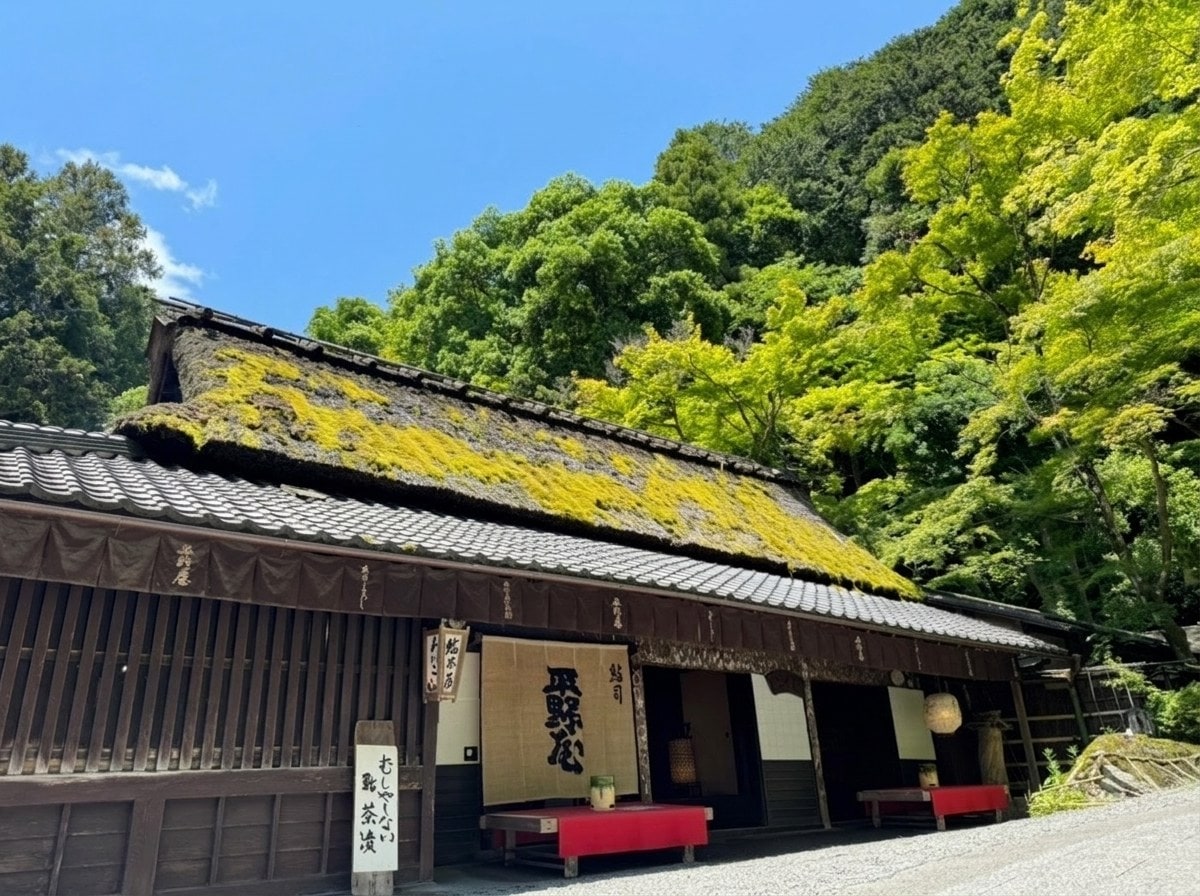
Hiranoya has stood at the foot of the first torii (shrine gate) of
Atago Shrine for roughly four hundred years, since the early Edo
period. Pilgrims climbing to the fire‑warding god stopped here for
tea, and the house doubled as an ayu wholesaler: ayu — the sweetfish,
a small river fish Japan prizes above almost any ocean catch — from
the Hozu river system rested overnight in its keeping and were
carried at dawn to the ryōtei (grand banquet restaurants) of Kyoto.
The okami — the woman who runs the house — is the fourteenth
generation of her family; her daughter, the fifteenth, serves beside
her. Even the newest room dates to the 1830s, and the whole building
stands inside the nationally protected Saga Toriimoto preservation
district.
What you eat
From June to mid‑October, wild ayu rest in a stone basin fed by
spring water from Mount Atago until the moment they are skewered and
salt‑grilled over charcoal — the fish’s melon‑like scent is the whole
argument for eating it hours from the river. In the young‑ayu weeks
there is segoshi, the fish sliced raw straight through the bone;
later, ayu sushi and a closing zosui (rice simmered in broth). Lunch
begins at ¥11,000, dinner at ¥18,000, with tax and service
extra. The other seasons keep their own registers:
matsutake mushroom courses from ¥26,000 in autumn, wild‑boar hot pot
in winter, mountain vegetables in spring.
The booking reality
The book is held by telephone only, at 075‑861‑0359, in Japanese —
there is no online calendar and no international platform. The eight
private tatami rooms seat two to twenty, so this is one of Kyoto’s
rare great rooms where a family or a party of eight books as easily
as a couple. Closures are irregular and announced month by month, and
cancellation fees run from two days prior — which is exactly why a
desk that calls, confirms the month’s calendar, matches your date to
the ayu season, and holds the room in Japanese earns its keep here.
Want Kyoto’s river‑fish tradition at its source rather than a course
in a hotel — or simply the teahouse side, which asks nothing but the
walk: shinko dango (steamed rice‑flour twists shaped, they say, like
the winding pilgrim path) with tea for ¥1,200, best reached on foot
up the preserved street from Adashino Nenbutsu‑ji, arriving as the
pilgrims did.
Free release-date alerts: the day before, on the morning of release day (08:00 JST) and about 30 minutes before when the time is known — or a weekly summary if the house opens a little every day.
Hiranoya: common questions
Can you book Hiranoya from abroad?
Yes, through our Tokyo desk. Phone only (075-861-0359), in Japanese — our desk makes the call. Cancellation fees apply from two days prior. The teahouse side needs no reservation. We call the restaurant for you, in Japanese, and the ¥6,000-per-seat fee is charged only if we confirm your table — no seat, no fee.
Some of these links are referral links: if you book through them we may earn a small commission, at no extra cost to you. Restaurants never pay us to be listed or ranked. Editorial policy
Cite this page
Facts on this page were checked by our Tokyo desk. You are welcome to quote them with a link: