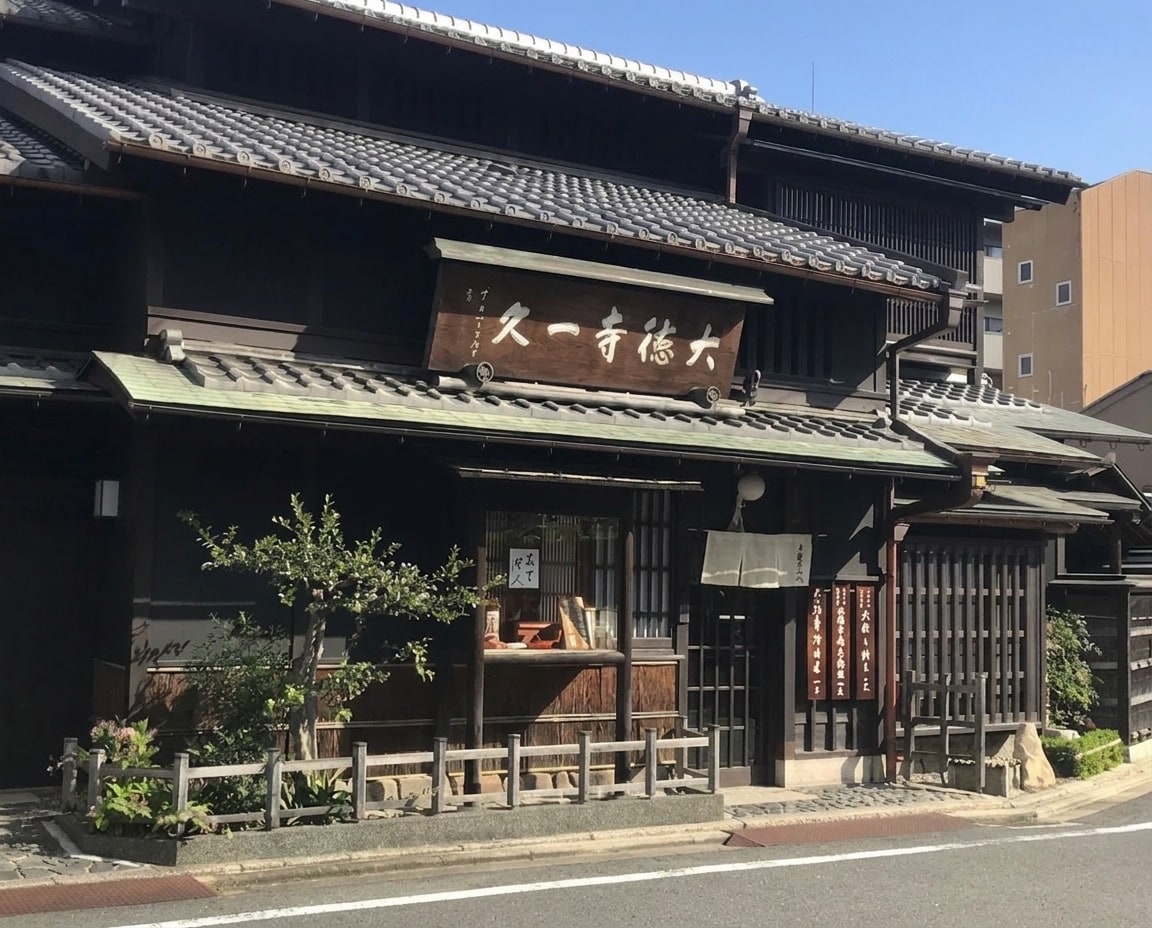
At the gate of Daitokuji, one family has served as the monastery's kitchen since the Bunmei era — more than 550 years of shōjin cuisine, still made only to order.
By SHOKU NOREN TeamFacts last verified September 2026How we check
In shortDaitokuji shōjin — the temple cuisine from which tea kaiseki grew, served as formal honzen. Reservations run in Japanese and are hard to place from abroad, so our Tokyo desk requests the table for you, by phone and in Japanese.
Price
Fuchidaka boxed course ¥6,050 · honzen ¥9,680 / ¥13,310 / ¥16,940 · tax and service included
Irregular — the house rests to Daitokuji's ritual calendar
Seats
Tatami rooms facing gardens, from private rooms to a hall for 80
Private rooms
Yes — from small tatami rooms to a hall for eighty, each facing a garden
Payment
Cards reported accepted — carrying cash is advised
Getting there
At the gate of Daitokuji — Daitokuji-mae bus stop, a walk from Kitaōji Station on the Karasuma subway line
In the Bunmei era (1469–87), in the years after the Ōnin War left Kyoto in ashes, one family took up the cooking for the great Zen monastery of Daitokuji. The same family does it still, at the temple’s gate — more than 550 years. House tradition holds that the name Ikkyu was bestowed by the Zen master Ikkyū Sōjun himself, one character altered out of reverence for the master’s own, and that the balancing of the five flavors — pungent, sweet, salty, sour, bitter — was taught by Daitokuji’s own abbots. That secret passes to a single heir each generation; the house today is one family of six, no employees.
What you eat
Shōjin ryōri — Buddhist temple cuisine, without fish or flesh — in its Daitokuji line, the wellspring from which tea kaiseki (the meal of the formal tea ceremony) later grew. It is served as honzen: courses arrayed on individual vermilion‑lacquered trays, the oldest formal table setting in Japanese cuisine. On the trays: the house’s trademarked Daitokuji‑fu wheat gluten, gisei‑dōfu (a pressed tofu‑and‑egg‑style square made meatless), ikada‑gobō burdock, seasonal vegetables and roots. Two forms: the fuchidaka boxed course at ¥6,050, served 12:00–16:00, and the honzen at ¥9,680, ¥13,310 or ¥16,940 depending on volume, entry 12:00–18:00 — tax and service included in every figure. The shopfront also sells Daitokuji nattō — not the sticky breakfast kind, but soybeans salt‑fermented under the summer sun by a method the house traces to Ikkyū — daily 9:00–18:00, from ¥500 for a 50-gram bag. It is the one thing here that asks no reservation.
The booking reality
The kitchen holds no stock of finished dishes: nothing is cooked without an order, so a walk‑in gets tea, not lunch. The fuchidaka window is reservation‑only by definition, and the closing days are set by Daitokuji’s ritual calendar — irregular in a way no listings site tracks. Booking means a Japanese phone call to 075‑493‑0019 (the house site also has a FAX booking form) that settles four things at once: a date the temple’s calendar allows, the course, the head count the kitchen will cook for, and the room. That is one call for our desk, and a wall for a hotel concierge working from a booking platform.
Want a quiet afternoon in north Kyoto, before or after the temple itself — and want to taste the cuisine the tea ceremony grew from, at the table that has laid it since the fifteenth century.
Free release-date alerts: the day before, on the morning of release day (08:00 JST) and about 30 minutes before when the time is known — or a weekly summary if the house opens a little every day.
Daitokuji Ikkyu: common questions
Can you book Daitokuji Ikkyu from abroad?
Yes, through our Tokyo desk. Phone in Japanese (075-493-0019) or the FAX booking form on the house site. Everything is cooked to order only, and Daitokuji's ritual calendar sets the closing days — confirm lead time and party size by phone. We call the restaurant for you, in Japanese, and the ¥6,000-per-seat fee is charged only if we confirm your table — no seat, no fee.
Some of these links are referral links: if you book through them we may earn a small commission, at no extra cost to you. Restaurants never pay us to be listed or ranked. Editorial policy
Cite this page
Facts on this page were checked by our Tokyo desk. You are welcome to quote them with a link: