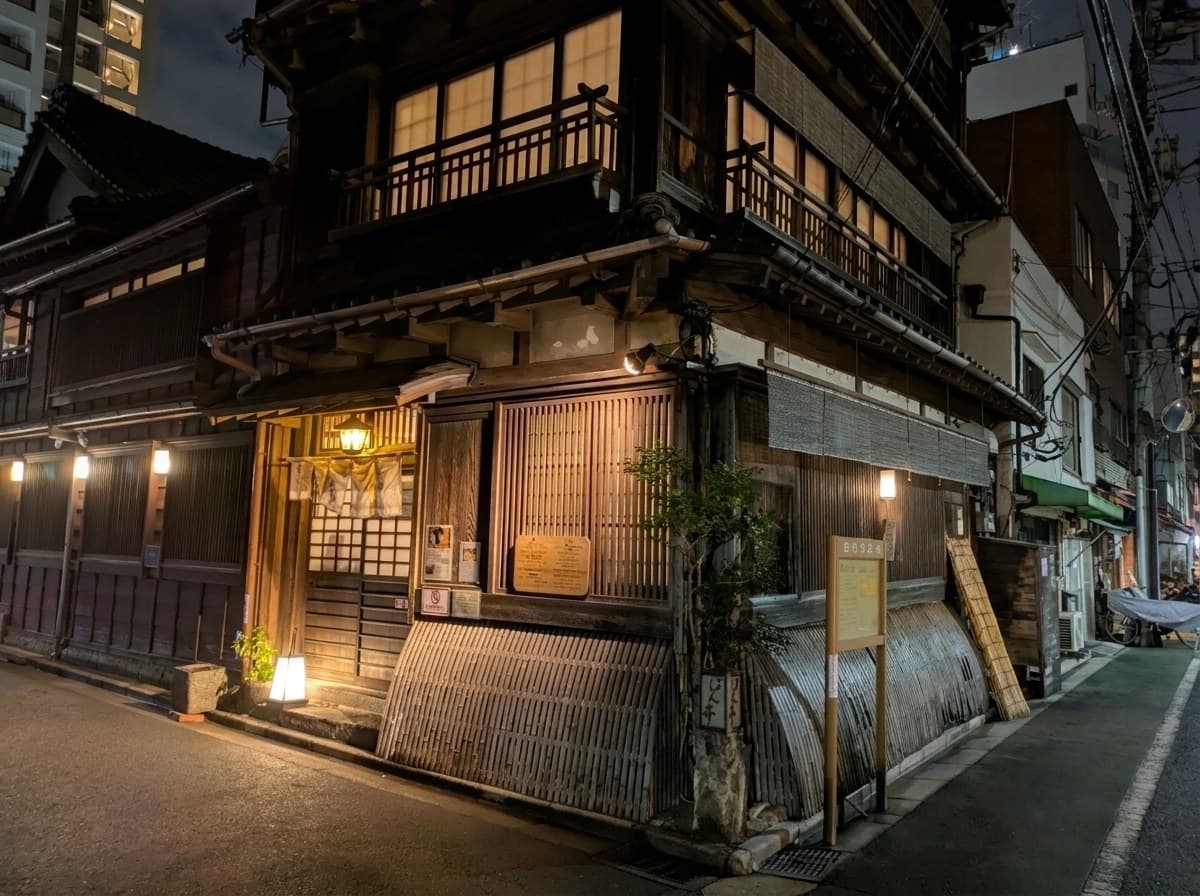
Hantei is a kushiage house in a three‑story wooden shop building one minute from Nezu Station, and one of the few landmark tables in Tokyo that a traveler can book alone, in English. Our notes on the house sit on Hantei’s restaurant page. TableCheck sells lunch and the twelve‑skewer dinners. The telephone carries everything else: the longer 15- and 18-skewer courses, groups of seven or more, and dates beyond the online calendar. Dinner begins at ¥6,600.
What kushiage is, and how Hantei serves it
Kushiage is an ingredient threaded on a skewer, coated in fine breadcrumbs and fried to order; Hantei serves it as a progression chosen by the kitchen. The house describes more than thirty kinds of skewer built from meat, seafood and vegetables, with produce taken at the front edge of its season. Standards include shrimp rolled in shiso and Yanaka ginger wrapped in pork; the September list adds sanma and matsutake.
Dinner opens with twelve skewers, served with two small side dishes, large‑cut cabbage, and sticks of cucumber, daikon and carrot to eat by hand with the house meat miso. The restaurant suggests sauce for the meat skewers and salt for seafood and vegetables. When the twelfth skewer has been served, staff ask whether you would like to continue. Any further skewers are different from the ones you have had, and you stop simply by saying you have had enough. The meal can close with ochazuke under a heap of nori, or rice with red miso soup.
Courses and prices
Prices include tax. The first three are listed on TableCheck as of 14 September 2026; the last two were confirmed with the house by telephone on 8 September 2026.
- Lunch (Hiruzen), ¥3,630. Eight skewers, small dishes, vegetable sticks with meat miso, ochazuke or rice with red miso soup, and dessert. Ninety minutes.
- Dinner (Yoruzen), ¥6,600. Twelve skewers, small dishes and vegetable sticks. No rice or dessert. Two hours.
- Dinner (Hantei course), ¥7,700. Twelve skewers, plus nori ochazuke and dessert. Advance reservation only. Two hours.
- Nagomi, ¥8,800. Fifteen skewers, with the finish and dessert. Two and a half hours. Phone only.
- Tokusen, ¥9,790. Eighteen skewers, with the finish and dessert. Two and a half hours. Phone only.
Additional skewers, rice and dessert can be added to the twelve‑skewer dinners.
A shop house from 1917
The Agency for Cultural Affairs lists Hantei as a Registered Tangible Cultural Property (building), entered on the register on 23 August 1999 and dated 1917: wood, three stories, a tiled roof, a footprint of 36 square metres. The register calls it a tall town house of three near‑identical floors, and a landmark of Nezu. Registration is a lighter form of national protection than designation as an Important Cultural Property. The restaurant’s own site places the house in the Meiji era and notes that it is built throughout in keyaki (zelkova) and came through the Great Kanto Earthquake of 1923.
The building began as a shop selling tsumakawa, the toe covers fitted to wooden geta in the rain. In a talk later published by the architecture press Gakugei Shuppansha, founder Haruo Takasu recalled running a small kushiage counter in Ueno, finding the house when it served as a company dormitory, and waiting about three years for the owners to sell. He restored it with real materials, named it Hantei, a half step (han) forward from his first shop, and later rented the house next door, where he found an earthen kura storehouse that became a dining room. Early this century a road widening cut away the front of the building; the scar is now covered by a large iron lattice, through which the old form of the house still shows.
Nezu and Yanaka
Nezu lies in the low ground just west of Ueno Park, with the temples and lanes of Yanaka a short walk to the north. Its anchor is Nezu Shrine: the main hall, worship hall, gates and fence completed in 1706 survive intact and are designated Important Cultural Properties. Each April the shrine’s slope of about 3,000 azaleas holds the Bunkyo Azalea Festival (1 to 30 April in 2026), and the neighbourhood is at its busiest. Our guide to Tokyo’s food neighbourhoods places the area in the wider city.
How booking actually works
- Online. The official site links to Hantei’s TableCheck page, which works in English; an OpenTable listing also exists. Hantei has a second branch in the Shin‑Marunouchi Building, so check that the page says Nezu. If the platform is new to you, see how TableCheck works.
- Telephone. 03‑3828‑1440, in Japanese. Call for Nagomi or Tokusen, for groups of seven or more, or when you cannot get a table online.
- How far ahead. The house told us by phone in September 2026 that reservations open two months before the visit date. The online calendar runs shorter: on 14 September 2026 it showed dates through 29 October, about six weeks ahead. For weekends, December and the longer courses, call on the day two months before your date.
- Time slots. Lunch is ninety minutes and the twelve‑skewer dinners two hours, counted from your reservation time, not your arrival. There is no waiting area and no seating before opening, so arrive on the minute. In the Japanese version of its policy, the house cancels tables more than fifteen minutes late without contact.
- Seats. Online bookings cannot choose seats.
- Changes. Same‑day cancellation is charged in full, and the party size cannot be reduced on the day. Parties of one to four may cancel until the day before; five to nine, a week ahead; ten to fourteen, two weeks; fifteen or more, three weeks. See cancellation culture in Japan.
- Requests. The notes field in the booking system is not monitored. Anything that matters must be raised by phone.
Making the call yourself
Tokyo runs on UTC+9 with no daylight saving, so work out the time at home before you dial. Call during opening hours, away from the peak of a service if you can. A short script is enough:
予約をお願いします。○月○日、夜、2名で、和みコースを希望します。
Yoyaku o onegai shimasu. [Date], yoru, ni‑mei de, Nagomi kōsu o kibō shimasu.
That asks for a dinner reservation for two on your date, on the Nagomi course; say Tokusen kōsu for eighteen skewers. Have your date, party size, name and a contact number ready, and repeat the date back when the staff confirm it. The longer courses are the real reason to call rather than click: more skewers, the rice finish and dessert, and an extra half hour at the table.
Practical notes
Everything is fried in the same oil. The house states that it has nothing it can serve to guests with allergies to wheat, egg, dairy, lard, sesame oil, nuts or alcohol, and that it cannot accept those bookings; other severe allergies should be discussed by phone before booking. Our guide to dietary needs helps with phrasing. The building has stairs, steps and tatami rooms, and is not barrier‑free; wheelchairs cannot be accommodated, and strollers must be folded. It is entirely non‑smoking, the street outside included. Bills cannot be split, and one receipt is issued per group.
Hours are 11:30 to 15:00 and 17:00 to 22:00, with dinner last orders at 21:00. The restaurant closes on Mondays, with changes around public holidays, and may close early on Sundays when ingredients run out. Tabelog lists cards and QR‑code payment, but not electronic money.
Hantei is easy to book yourself, and because it is in our collection, our desk can also request it by phone; if no seat can be secured, nothing is charged. For the Tokyo counters that answer only a Japanese phone line, see how to book restaurants in Tokyo; where one of those is in our collection, our desk can make the call through the request form.