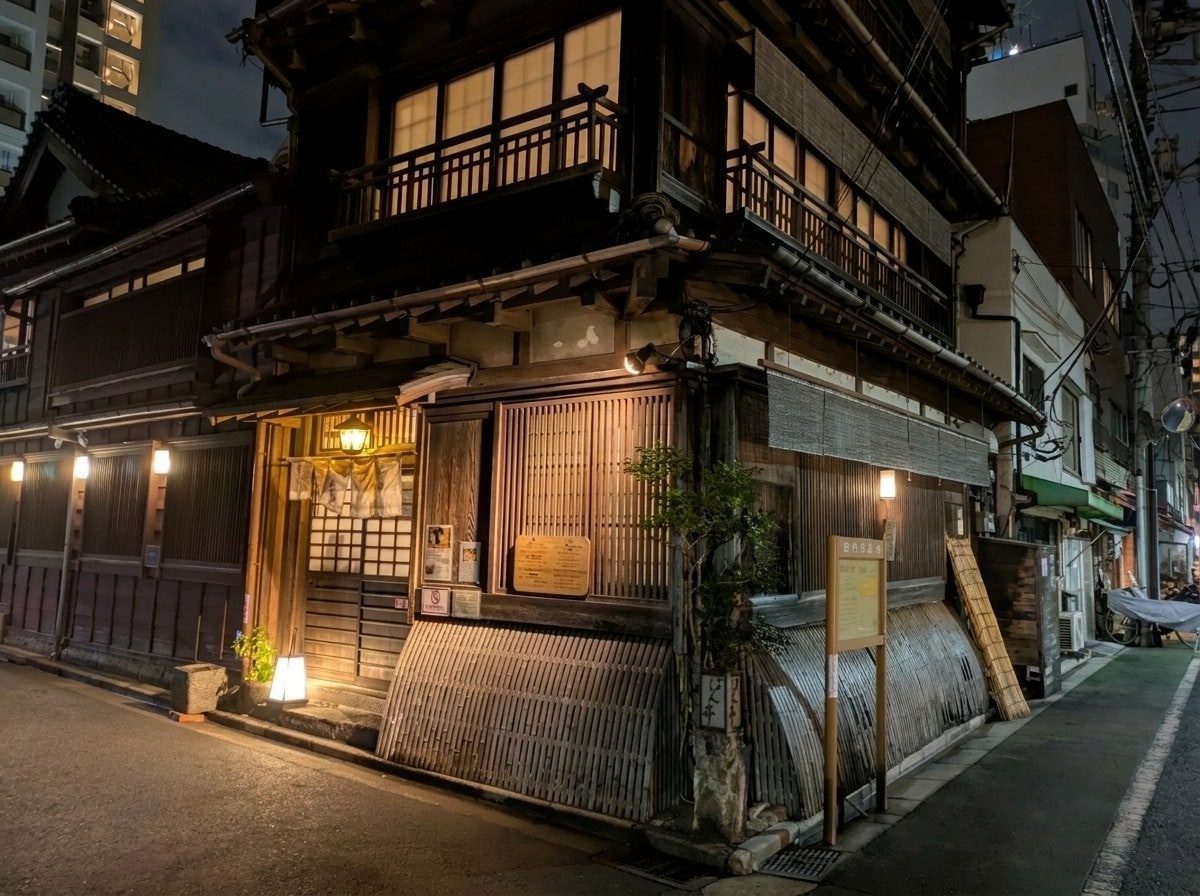
Wooden three‑story buildings were once the skyline of low‑city Tokyo; almost all of them are gone now. Hantei occupies one of the survivors: a 1917 geta (wooden‑clog) merchant’s shop, now a nationally registered cultural property, saved in the 1970s by a restaurateur who fell in love with the building first and invented the restaurant to live inside it.
The house went up in 1917 as a wholesaler’s shop dealing in tsumakawa — the little rain guards fitted to the toes of wooden clogs — three full floors of timber stacked on the same footprint, a form the fire codes would never permit again. It rode out the Great Kanto Earthquake of 1923, and in 1999 the government wrote it into the register of tangible cultural properties. A kura storehouse stands beside it. The kushiage — skewers fried in fine breadcrumbs — has been frying here long enough that the restaurant and the landmark are now the same thing.
What you eat
There is no menu. Kushiage — panko‑crusted skewers, fried in a blend of four oils to an almost weightless crispness — arrive as the kitchen chooses: shrimp with shiso, lotus root, seasonal fish, wagyu, each with its own sauce. When the opening twelve have been served, staff ask whether you would like to continue; any further skewers are different kinds, and you stop simply by saying you have had enough. Between rounds the kitchen paces you the old fry‑shop way: a couple of small hashiyasume palate cleansers, raw vegetable sticks with miso, and hunks of crisp cabbage — a rhythm built so that twelve skewers feel light and eighteen feel entirely possible. Lunch runs the same ritual, shorter and cheaper.
How a visit works
Booking is the easy part — rare praise on this list. Hantei sells its tables through English‑language online reservation pages as well as by phone, seats solo diners without fuss, and asks only that you respect the slot: seatings are strict, and the frying begins when you sit.
Dinner comes as four set courses, from twelve skewers alone to the longer Nagomi and Tokusen, which the house sells by phone only. For weekends — and late April, when the azaleas at Nezu Shrine pull half of Tokyo through the neighborhood — book on the day the line opens; weeknights can often still be booked a few days out.
Online bookings cannot choose seats, and the notes field is not monitored: any request has to be made by phone. Everything is fried in shared oil, so the house cannot accept guests with allergies to wheat, egg, dairy, lard, sesame oil, nuts or alcohol, and the building is not wheelchair accessible.
The Noren View
Hantei is the gentlest door into our collection: English online booking, child‑friendly, and dinners at the gentle end of the price range. What you’re really reserving is the architecture — and the neighborhood. Nezu is the capital of surviving old Tokyo: the shrine’s azalea tunnels, Yanaka’s lanes and cemetery cherry trees, the students’ bookshops of Hongō. End that walk here, upstairs, as the paper lanterns come on.
Who it’s for
First‑week‑in‑Japan travelers who want atmosphere without ceremony, families, and architecture lovers. This is dinner inside the building the preservationists point to.