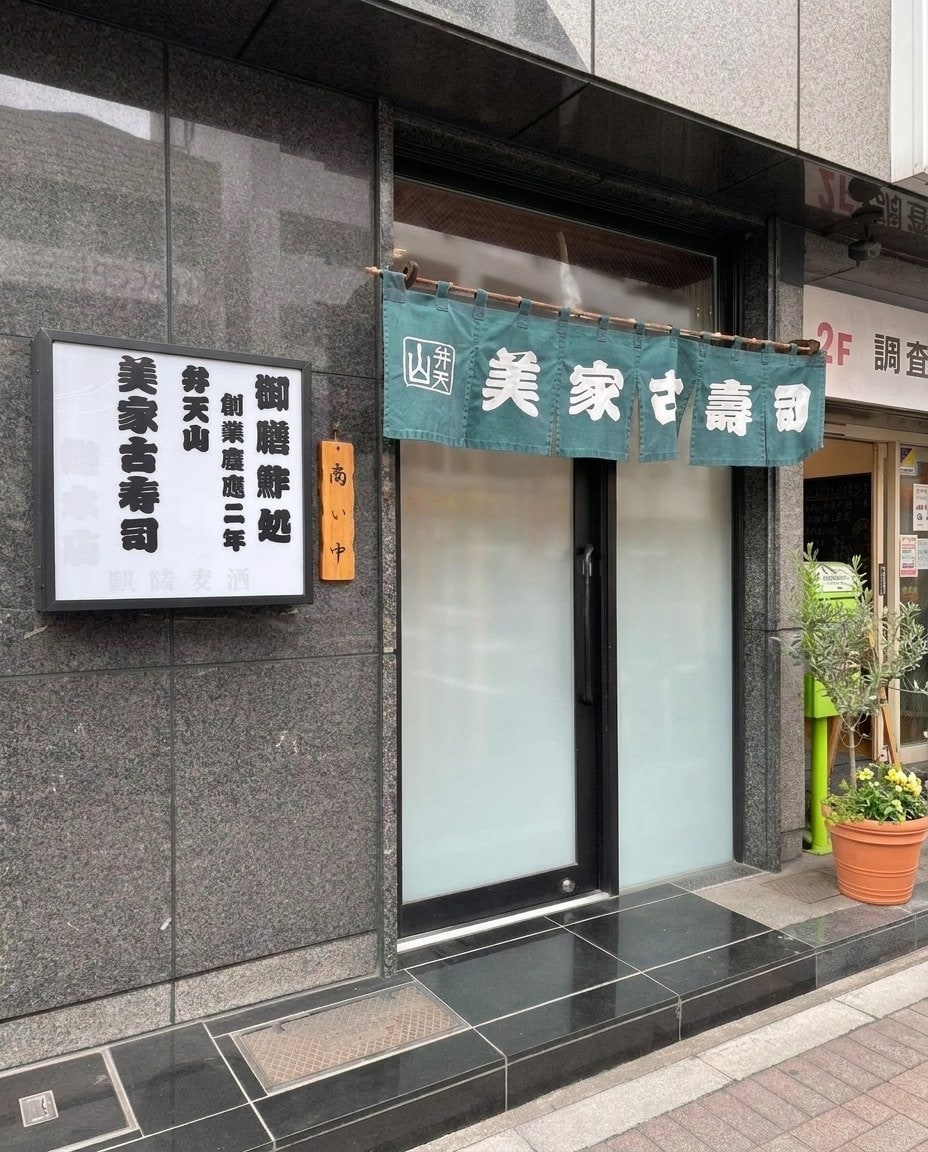
In shortClassical Edomae sushi — the pre-refrigeration canon. Reservations run in Japanese and are hard to place from abroad, so our Tokyo desk requests the table for you, by phone and in Japanese.
Price
Courses ¥8,800–18,260 (tax included) · zuke-don from ¥3,300
Asakusa Stn, 3 min walk — beside the temple's old bell tower where the house was founded in 1866
Before refrigeration, Edomae sushi was preservation: fish cured in
vinegar, steeped in soy, simmered, pressed — the only ways to sell it
safely from an Edo street stall. Bentenyama Miyakozushi has served that
original canon since 1866, when its founder, trained in the school of
Hanaya Yohei — the man credited with inventing nigiri itself — opened
beside the bell tower of Sensō-ji. The house still works the full old
grammar: zuke (soy‑marinating), sujime (vinegar‑curing),
kobujime (pressing fish between sheets of kelp), nikiri (the
brushed‑on seasoned soy) and tsume (the dark simmering glaze). The
fifth master, Tadashi Uchida — a published historian of sushi — puts it
with a grin: “Raw is the fashion now. Our sushi is out of date.” The
sixth (his top apprentice, not his blood) keeps it that way,
deliberately.
What you eat
Kohada (vinegar‑cured gizzard shad, the piece Edomae chefs are judged
by), tuna steeped in soy, conger eel simmered soft and lacquered with a
tare (glaze) fed and handed down for generations, boiled clam, squid
worked the old way, an omelet folded with shrimp paste. Courses run
¥8,800 to ¥18,260 and arrive a few pieces at a time on wooden geta
stands, so nothing sits drying while you eat. The manga Oishinbo —
Japan’s great food comic — made the fifth master a recurring character;
its author is said to head here straight from the airport.
The booking reality
Tabelog’s online booking takes both counter and table seats, and the phone (03‑3844‑0034, in Japanese) works too — and the house means its rules: arrive more than thirty minutes late and the
reservation is cancelled outright. Sixteen seats, closed Mondays and
the first and third Sundays, but the other Sundays run a continuous
12:00–18:00 service — a mid‑afternoon sushi slot almost nothing serious
in Tokyo offers, and the natural pairing with a Sensō-ji morning. Either route books it inside a normal planning window; our desk can make the booking and confirm the thirty‑minute rule and the right Sunday before you fly.
Have eaten your fill of “fresh” and want the version with two centuries
of technique instead of a walk‑in fridge — or you’re building an
Asakusa day and want the temple, the bell tower, and the cuisine born
beside them in a single afternoon.
Free release-date alerts: the day before, on the morning of release day (08:00 JST) and about 30 minutes before when the time is known — or a weekly summary if the house opens a little every day.
Bentenyama Miyakozushi: common questions
Can you book Bentenyama Miyakozushi from abroad?
Yes, through our Tokyo desk. Online via Tabelog or by phone in Japanese. Open Sunday afternoons — rare gold for travelers. Thirty minutes late and the reservation is cancelled. We call the restaurant for you, in Japanese, and the ¥6,000-per-seat fee is charged only if we confirm your table — no seat, no fee.
Some of these links are referral links: if you book through them we may earn a small commission, at no extra cost to you. Restaurants never pay us to be listed or ranked. Editorial policy
Cite this page
Facts on this page were checked by our Tokyo desk. You are welcome to quote them with a link:
Bentenyama Miyakozushi — Asakusa, Tokyo — SHOKU NOREN (checked September 2026). https://shokunoren.com/restaurants/miyakozushi-asakusa