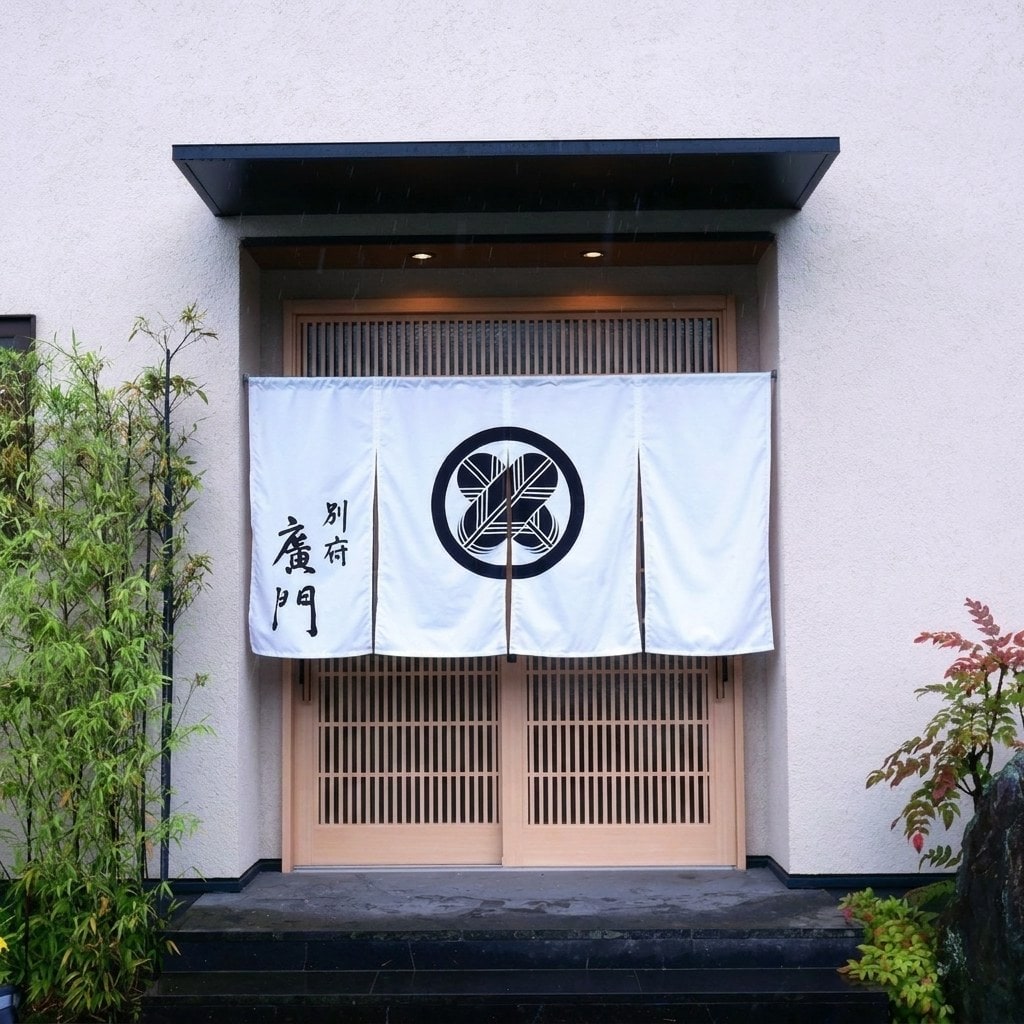
In shortKappō — "zero hours from the sea". Reservations run in Japanese and are hard to place from abroad, so our Tokyo desk requests the table for you, by phone and in Japanese.
Price
Omakase ¥33,000 tax incl. (lunch & dinner), ¥35,000 from December 2026; short regional courses appear some months. Prices are indicative, as listed on TableCheck (October 2026).
Hours
Lunch 12:00 · Dinner 18:00 — one simultaneous seating, about three hours
Closed
Sundays & Mondays (irregular)
Seats
8 — counter only
Private rooms
None — buyout from seven guests
Payment
Cards, e-money and QR codes all accepted · no service charge
Getting there
Beppu, Oita — fly to Oita Airport (100 min from Tokyo) + 45 min airport bus; the counter is a taxi ride into the hills
Children
Primary school age and over
Dress code
No dress code
Beppu produces more hot‑spring water than anywhere in Japan — a town
of rising steam, “hell” ponds and sand baths, but never, until 2021, a
counter people flew in for. Taizo Hirokado was born here in 1982, left
after high school for Kashiwaya, an Osaka ryotei
(grand traditional restaurant) with Three MICHELIN Stars (MICHELIN Guide Japan 2026), apprenticed in buckwheat noodles under
Kunihiro Takahashi of Tatsuma — the man Japan calls the god of soba —
then spent 2016 to 2020 as second‑in‑command at Ginza’s
Shinohara before coming home. His eight seats face a stone garden in
the Horita hills above the bay, and he keeps three apprentices of his
own, on the theory that a cook shouldn’t have to leave Kyushu to
become first‑rate.
What you eat
His organizing idea is zero hours from the sea: fish carried from
the harbor still alive in seawater — ayu (sweetfish), octopus, shrimp
sometimes shown still moving — then white fish sliced so thin the
plate’s pattern reads through it, a texture that decays in transit and
so cannot exist in Tokyo. His hamo (pike conger, a bony summer eel)
skips the usual bone‑cutting entirely; the fine bones are drawn out
one by one, spring through autumn. Handmade soba from the Takahashi
years lands mid‑course — the reason the house cannot seat buckwheat
allergies — and he holds a fugu (pufferfish) license for winter.
Nearly everything is Oita and Kyushu. Tabelog Award Silver in 2025 and
again in 2026, within five years of opening.
The booking reality
Everything releases at once: the 1st of each month, 10:00 JST, three
months of seats, online only. Then the fine print — one visit per
guest per month, children only with the house’s paid babysitting
service (¥9,900, tax included) unless you hire the counter, arrive ten minutes early. Prices are indicative, as listed on TableCheck (October 2026).
(twenty minutes late cancels the meal), 30% charged from seven days
out and 100% from the day before. Sundays and Mondays close
irregularly. It is exactly the kind of book a desk in Tokyo is built
for: we sit on the release minute, read the rules in Japanese so none
of them surprises you, and keep watching the booking pages for seats
that free up mid‑month.
Are building an onsen itinerary around Beppu’s hells and sand baths
and want the meal to be the equal of the baths — or want to taste what
a Ginza‑caliber kitchen does when the fish is minutes old and the rent
isn’t Ginza’s.
The house's cancellation charge
From 00:00 JST, 7 days before30%
From 00:00 JST, 3 days before50%
From 00:00 JST, 1 day before100%
Same day, with notice100%
Same day, no notice (no-show)100%
Charged by the house, not by us. A plan's own policy takes precedence.
Free release-date alerts: the day before, on the morning of release day (08:00 JST) and about 30 minutes before when the time is known — or a weekly summary if the house opens a little every day.
Nihonryori Beppu Hirokado: common questions
Can you book Nihonryori Beppu Hirokado from abroad?
Yes, through our Tokyo desk. Slots open all at once on the 1st of each month at 10:00 JST, three months out, online only (TableCheck and OMAKASE). One visit per guest per month; soba allergies cannot be accommodated; 100% charge from the day before. We call the restaurant for you, in Japanese, and the ¥6,000-per-seat fee is charged only if we confirm your table — no seat, no fee.
Some of these links are referral links: if you book through them we may earn a small commission, at no extra cost to you. Restaurants never pay us to be listed or ranked. Editorial policy
Cite this page
Facts on this page were checked by our Tokyo desk. You are welcome to quote them with a link: