In shortSushi — Aomori's own catch, served in a 1913 storehouse. Reservations run in Japanese and are hard to place from abroad, so our Tokyo desk requests the table for you, by phone and in Japanese.
Hours
11:30–14:30 / 17:00–21:00
Closed
Irregular holidays, announced month by month — call ahead
Seats
About 70 — a ten-seat counter and tables downstairs, chair-seated private rooms upstairs (largest holds 25)
Private rooms
Yes — second-floor chair-seated private rooms (two for 6, one for 8, one for 25), booked by phone (017-722-2639)
Payment
Major cards · transit e-money · iD/QUICPay · main QR payments
Getting there
Shinmachi, central Aomori — a seven-minute walk from Aomori Station
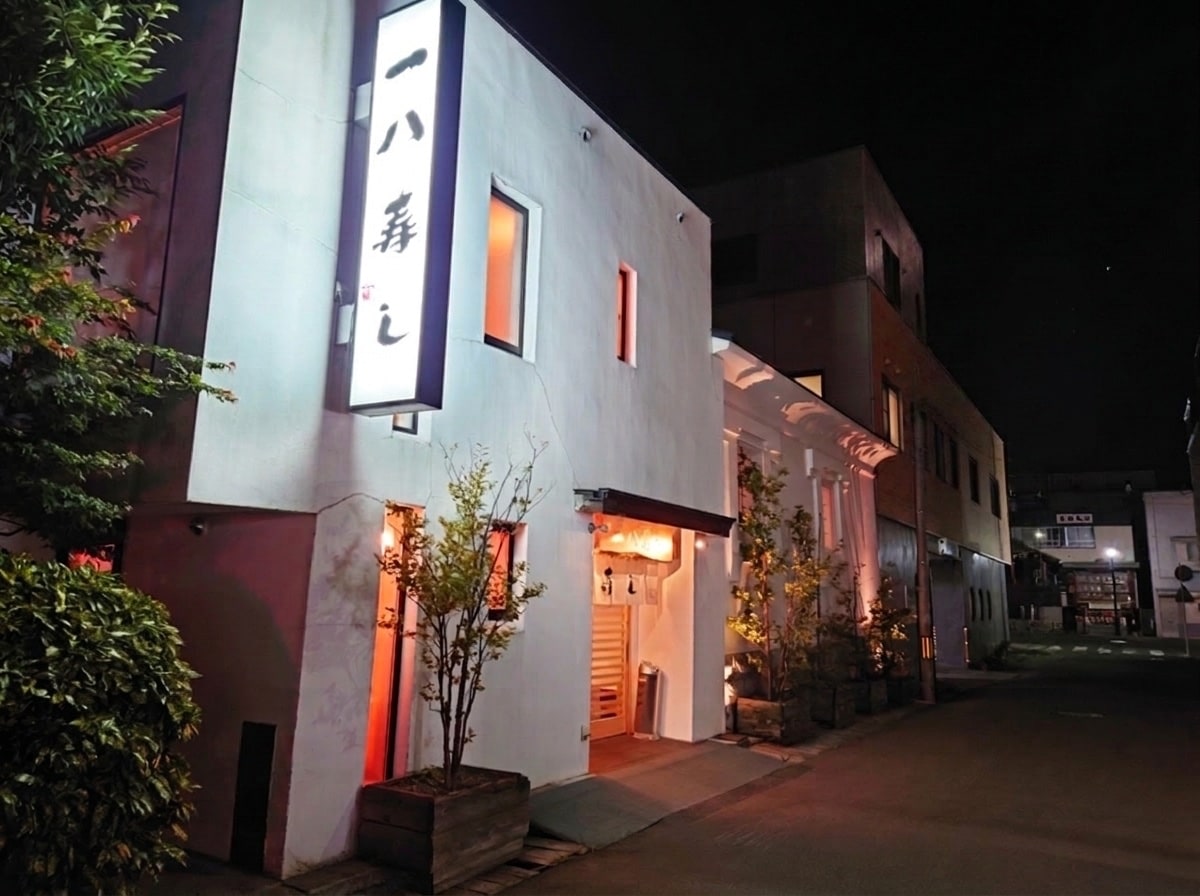
Ippachi opened in the late 1950s, when its founder, Nishimura Chikara, chose a name that reads like a wish: begin with one, end with eight — the numeral whose written form opens outward, the old Japanese sign of a future that widens. The building is older than the shop: an earthen‑walled kura — the thick‑walled fireproof storehouse of merchant Japan — raised in 1913, its walls now keeping sushi instead of stored goods. Tabelog, Japan’s dominant restaurant‑review site, named it to its Sushi EAST Hyakumeiten — the top hundred sushi restaurants of eastern Japan — in 2021.
What you eat
There is no Edomae posturing here — no attempt to replay Tokyo’s aged‑and‑cured style. The fish is Aomori’s own: hirame (flounder) and hotate (scallop), raw uni from Mutsu Bay, and in season hon‑maguro — bluefin tuna — landed at Ōma, at the northern tip of the Shimokita Peninsula, whose tuna sets the price ceiling at Tokyo’s new‑year auctions. The menu is graded the old way — ume, take, matsu, gokujō, plum to supreme — and okonomi (piece‑by‑piece ordering) beyond that. Lunch costs far less.
The counter and the rooms
Here is the honest quirk, and the house states it plainly: the ten‑seat counter cannot be reserved. It is walk‑in only, taken in the order the door admits you. What can be booked — by phone, in Japanese — are the tables and the second‑floor private rooms, which are chair‑seated rather than floor‑seated: two taking six, one eight, and one twenty‑five, which is how the house reaches its seventy seats. Weekdays are often kind to walk‑ins; on weekends a queue forms before opening, and during Nebuta week in early August the reservable seats sell out. Hours run 11:30–14:30 and 17:00–21:00, and the closing days are irregular, announced month by month — February 2026, for instance, closed five scattered dates. That is the real work: a Japanese phone call to confirm the month’s holidays, book a table or room if you want one, and time your arrival for the counter. It is exactly the call this desk makes.
Save it for
A traveler who wants Aomori on the plate rather than Tokyo transplanted north — and who does not mind a short wait for a counter that money cannot hold.
Free release-date alerts: the day before, on the morning of release day (08:00 JST) and about 30 minutes before when the time is known — or a weekly summary if the house opens a little every day.
Ippachi Sushi: common questions
Can you book Ippachi Sushi from abroad?
Yes, through our Tokyo desk. The counter cannot be reserved — walk-in only, first come. Tables and the second-floor private rooms are booked by phone (Japanese). Our desk books a table or room and advises timing for the counter. We call the restaurant for you, in Japanese, and the ¥6,000-per-seat fee is charged only if we confirm your table — no seat, no fee.
Some of these links are referral links: if you book through them we may earn a small commission, at no extra cost to you. Restaurants never pay us to be listed or ranked. Editorial policy
Cite this page
Facts on this page were checked by our Tokyo desk. You are welcome to quote them with a link: