Fukuoka’s airport sits five kilometers from downtown — five minutes by subway to Hakata station. No other gateway in Japan puts you at a food stall the same evening you clear customs. That accident of geography makes northern Kyushu the easiest great food route in the country, and almost no overseas itinerary uses it.
Night 1 — Fukuoka’s yatai
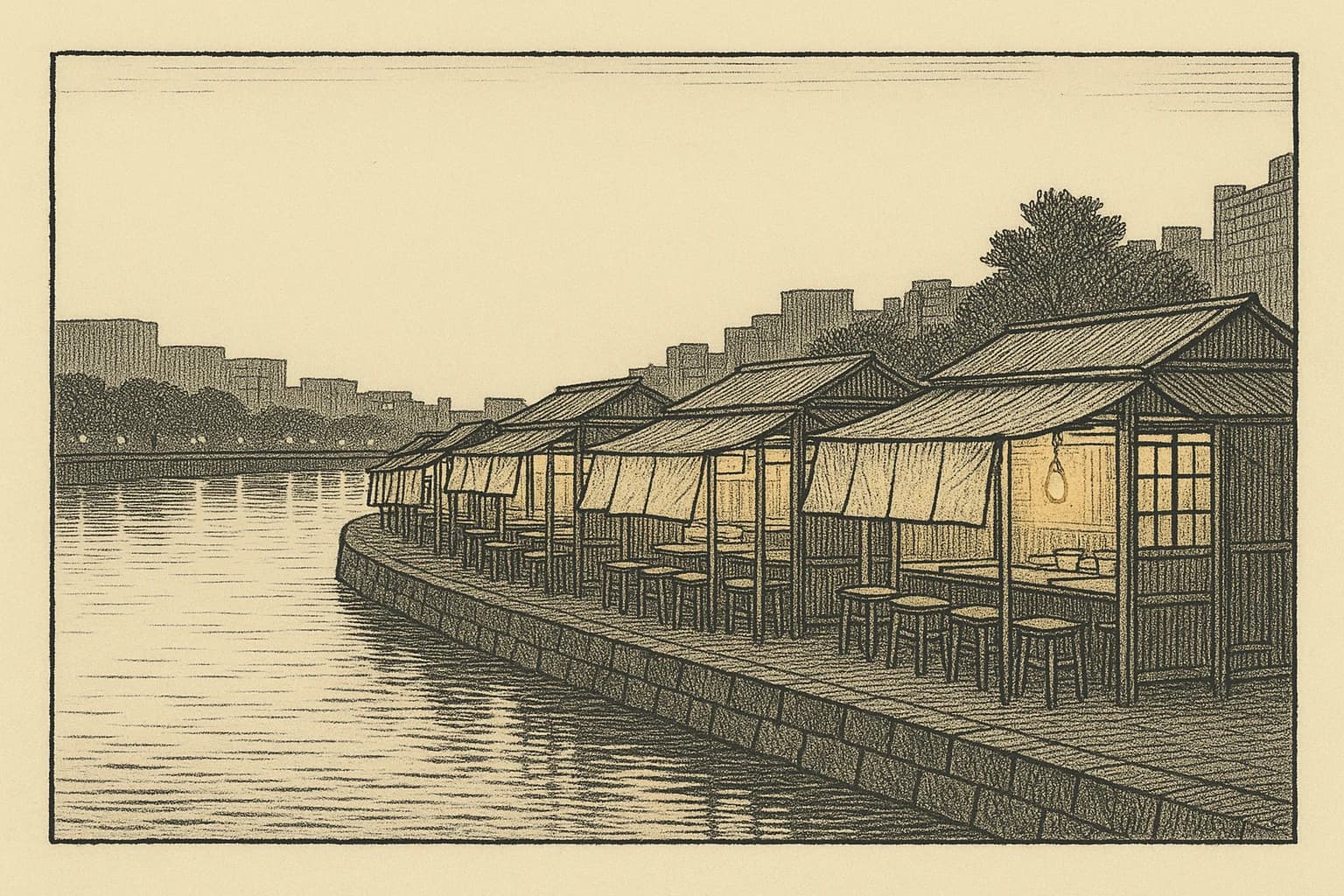
The city’s open‑air food stalls light up from about 6 p.m. — Nakasu’s riverside row, Tenjin’s street‑corner classics (Kokin‑chan invented the yaki‑ramen), even a French‑run stall pouring wine under the lanterns. The rules are simple: order at least one dish per person, expect a small cover charge at some stalls, carry cash, travel light. Budget a few thousand yen and hop stalls. At the other end of the spectrum, Fukuoka is home to a sushi legend, Gyoten (three stars in the 2019 Fukuoka‑Saga‑Nagasaki guide) — but its ten seats are for members only, and as of September 2026 its official site says new memberships are suspended, so it is not a table a visitor can plan for.
Day 2 — Karatsu: pottery, then the counter
A direct local train runs from the airport line to Karatsu in about 90 minutes — a castle town on the Genkai Sea. Spend the afternoon at the Ryūta kiln of the Nakazato potters, whose ceramics you will eat from that evening at Sushidokoro Tsukuta (see our profile): seven seats, Edomae technique learned at Ginza’s Kiyota, two Michelin stars in the 2019 regional guide, at roughly half Tokyo’s price for the level. Sleep at Yōyōkaku, the 1893 wooden ryokan with its own pottery gallery.
Day 3 — Yobuko squid, then the steam
Thirty minutes north, Yobuko’s morning market has run daily since the whaling era; the harbor restaurants serve squid so fresh it arrives transparent, still moving (season roughly March–November). Then swing back through Hakata and take the Sonic express east: Beppu, Japan’s most prolific hot‑spring town. Bathe in sand, tour the cobalt “hells,” and end at Hirokado (see our profile) — if you won its online‑only release, on the 1st of each month at 10:00 for dates three months out, which is exactly the kind of thing our desk does.
Day 4 — and beyond
Fly out of Oita, or double down: the Kyushu Shinkansen reaches Kagoshima in 80 minutes from Hakata, where Sushisho Nomura serves one bay’s fish at eight phone‑only seats under a smoking volcano.
Getting there, realistically
Everything above runs on rail — the only car‑optional segment is Karatsu–Yobuko. Total dining spend for the route’s three flagship dinners: roughly ¥90,000 per person, less than one trophy dinner in (as of July 2026) Ginza. The hard parts are Hirokado’s release day, Nomura’s Japanese phone line (the house books overseas guests only through a hotel concierge, so we do not take requests for it), and sequencing the seasons (squid in the warm months, fugu and crab in winter). Tell us your dates; this is the itinerary we most enjoy building.